
Think Cinematic: A Different Way to Approach Photography
Aug 20, 2026
Written by David Mazur · 13 min read · Seeing & Composition
We’ve all watched the credits roll at the end of a movie and seen the Director of Photography listed prominently alongside the director, producers, and lead actors. There’s a reason for that.
The Director of Photography or Cinematographer doesn’t determine what the story is about. The screenplay and director largely establish that. The cinematographer helps determine what the story looks like, feels like, and ultimately how we experience it.
Think about that for a moment. A screenplay might contain a simple sentence: “A man walks alone across a field toward his childhood home.” That's the story. But how should it feel? Lonely? Nostalgic? Threatening? Peaceful? Hopeful? Those decisions aren't found in shutter speed, aperture, or ISO. They are created through light, composition, lens choice, perspective, color, exposure, distance, movement, and timing.
This is where filmmaking has something important to teach photographers.
The Director of Photography is responsible for the movie's photographic visual language. That includes decisions about:
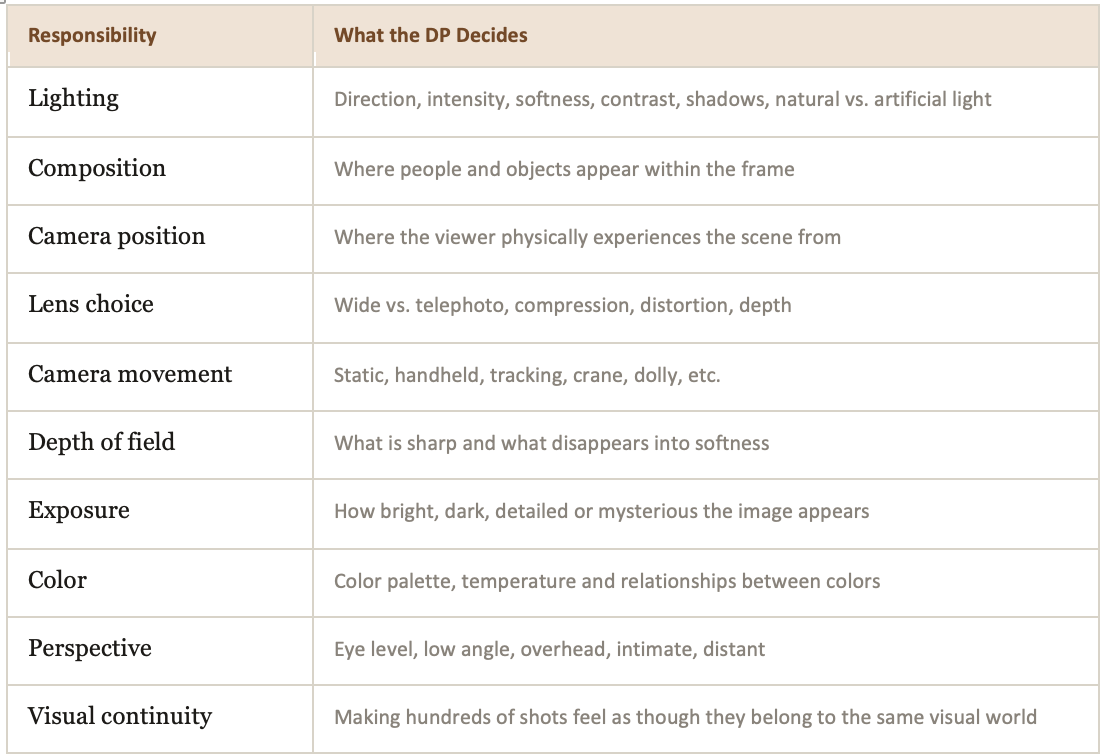
The DP also leads the camera and lighting departments and works closely with the production designer, gaffer, camera operators, colorist, and others.
But here's why the role really matters. Imagine a script says: “A man walks alone across a field toward his childhood home.” Those words don't tell us how the audience should feel. The DP could photograph him with a 24mm lens from a distance, making the person appear tiny against an enormous landscape. The message becomes: Isolation. Move close with an 85mm lens, a shallow depth of field, and a warm backlight: Nostalgia. Underexpose the scene and use cold blue light: Fear or uncertainty. Same actor, house, field, and script. Four completely different stories. That's why cinematography isn't simply camera operation.
The DP controls what you notice
This is where cinematography becomes especially interesting from a photography perspective. The audience sees a rectangle containing potentially hundreds of pieces of visual information. The DP manipulates light, focus, composition, color, movement, and perspective to determine where your attention goes first and where it goes next.
- Bright before dark.
- Sharp before blurry.
- Contrast before similarity.
- Faces before many other objects.
- Movement before stillness.
- Saturated color before muted color.
The DP is essentially engineering the viewer's attention. And that means cinematography has a close relationship with how still photographers learn to see.
The Photographer Is Both Director and Director of Photography
When you make a photograph, you're actually performing two jobs. First, you are the director asking: What am I trying to say? Then you become the Director of Photography asking: How can I make the viewer see and feel what I want them to? That distinction represents one of the biggest transitions photographers make as they progress.
Beginners tend to ask: What aperture, shutter speed, and ISO should I use? Those are necessary questions when you're learning the camera. Eventually, however, the better question becomes: What do I want this photograph to communicate? And only then: What photographic decisions will communicate it? The camera becomes the instrument rather than the objective.
Same Scene. Four Different Photographs.
Imagine that person walking toward the house again. Photograph them from far away with a wide-angle lens, making the person tiny within an enormous landscape. The photograph says isolation. Move close, use a longer lens, shallow depth of field, and warm backlighting. Now it says nostalgia. Underexpose the scene, introduce cooler tones, and allow large areas to disappear into shadow. Now it feels ominous. Put the house precisely in the center, establish strong symmetry, carefully control the color relationships, and position the person deliberately within the geometry. Nothing necessarily changed in the subject. What changed was the photographer's interpretation of it. That is visual storytelling.
Wes Anderson: Framing Consistent Order in the Chaos
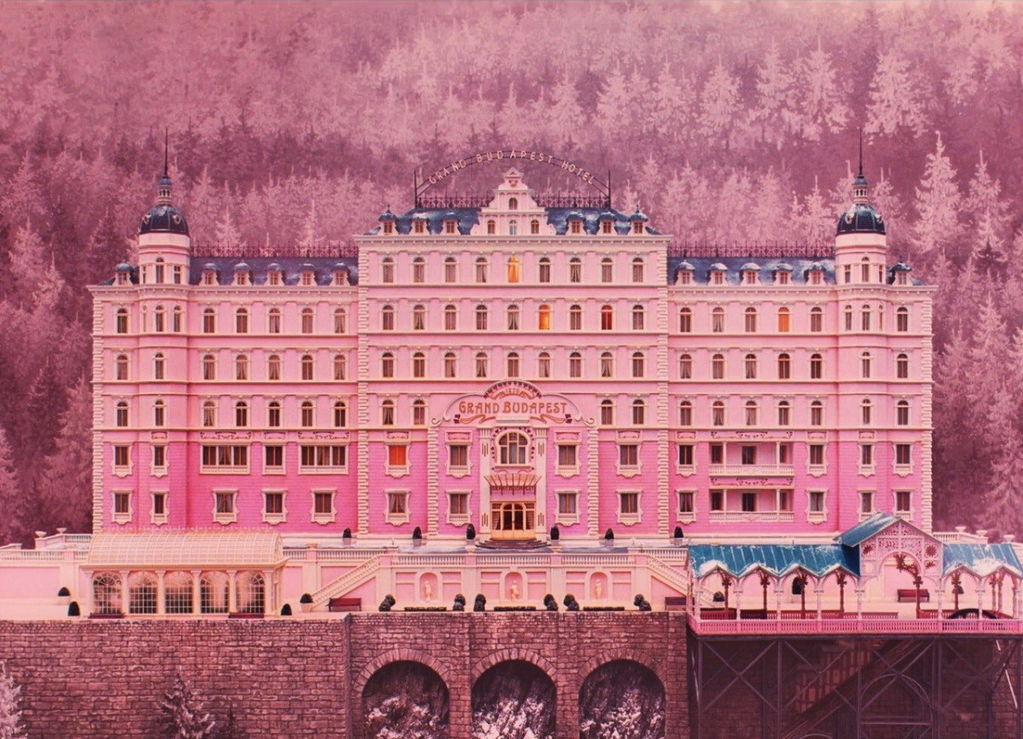
Anderson has worked for decades in over 10 films with Director of Photography Robert Yeoman. Anderson has a very strong visual vision, but Yeoman helps translate that conceptual vision into photographic decisions. To make the frame feel artificial, nostalgic, and meticulously ordered, it has to determine:
- Where does the camera go?
- Which lens?
- What height?
- What exposure?
- What lighting?
- How much depth of field?
- Where does the horizon fall?
- Where do the actors stand?
- What moves the actor or camera?
Those are cinematographic decisions that are a great lesson here for still photographers. When you walk up to a landscape, you're the director; you decide what you are trying to say about this place. Then you become the Director of Photography: How can light, lens, position, perspective, composition, exposure, color, and timing make the viewer feel what I want them to feel? That distinction is profound.
Beginners often start with “what settings should I use?” More advanced photographers increasingly ask “what do I want this photograph to communicate?” And then: “what photographic decisions will communicate it?” That's essentially cinematography compressed into one frame and a useful framework for teaching photographers the transition from operating a camera to creating a visual experience.
Director Wes Anderson and longtime cinematographer Robert Yeoman provide a wonderful starting point for photographers. Anderson's visual world is immediately recognizable: symmetry, central compositions, carefully organized geometry, coordinated colors, negative space and seemingly obsessive attention to what occupies the frame. But reducing the Anderson look to symmetry and pastel colors misses the larger lesson.
Anderson organizes the world. For a photographer, that means walking into a visually chaotic environment and searching for relationships:
- Where is the center?
- What repeats?
- Which lines correspond?
- Which colors belong together?
- What doesn't belong?
- What happens if I move three feet left?
- What if I lower the camera?
- What if I photograph the scene perfectly perpendicular rather than diagonally?
- The photograph isn't simply discovered.
Its consistent visual order holds the attention of the audience throughout the movie.
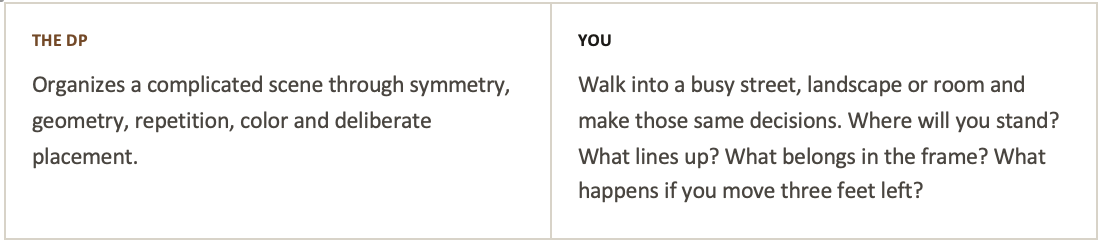
Different scale. Same visual decisions.
Roger Deakins: Simplify Until the Viewer Knows Where to Look
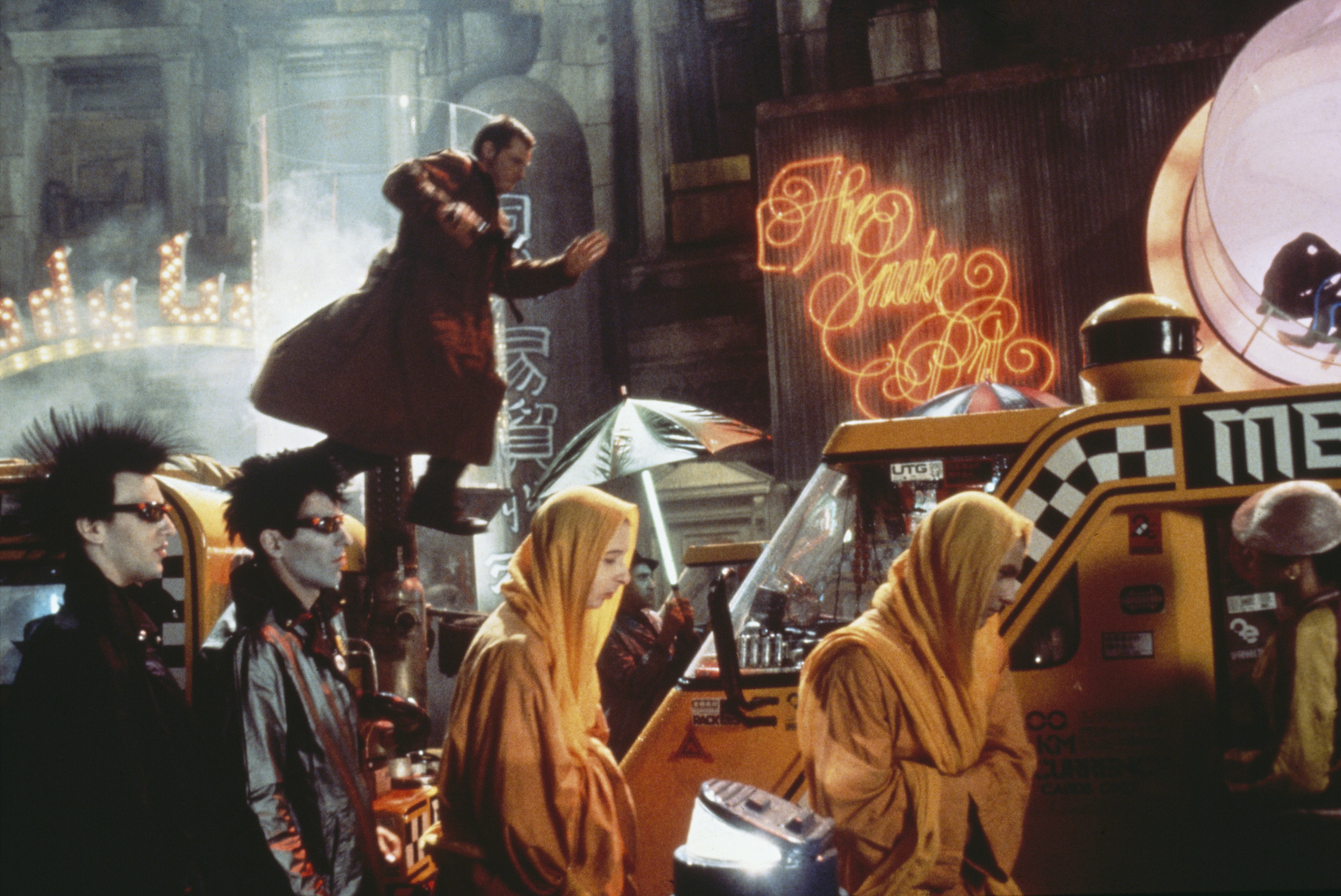
Now consider cinematographer Roger Deakins, whose films include 1917, Skyfall, Blade Runner 2049, No Country for Old Men and Sicario. One of the lessons evident in Deakins' work is the extraordinary power of simplicity and controlled attention.
In discussing his work with director Denis Villeneuve, Deakins has described using architecture and other elements within a scene to restrict the frame and reduce visual information, thereby directing the audience toward what matters.
That's an enormously useful lesson for still photographers. Before pressing the shutter, ask: What do I want the viewer to see first? Then ask: What is competing with it? Sometimes improving a photograph isn't about adding something. It's about removing everything that doesn't contribute to the scene.
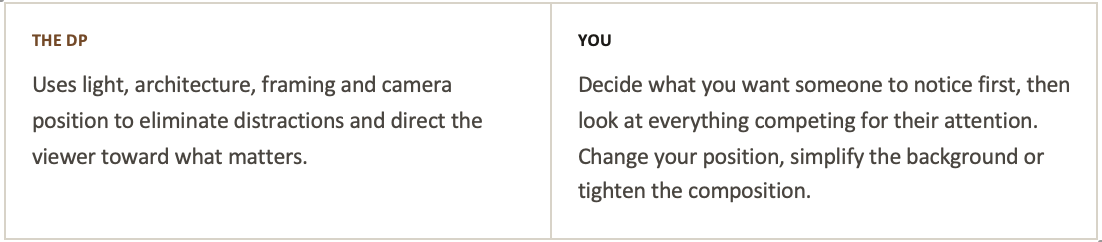
The DP controls the movie frame. You control yours.
Gordon Willis: Don't Be Afraid of Darkness
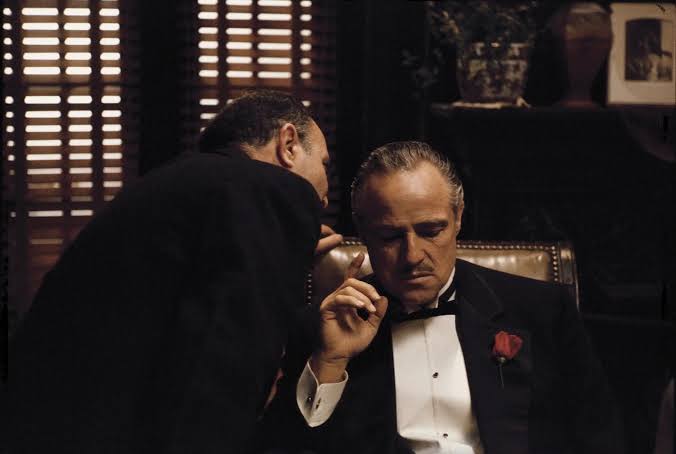
Perhaps no cinematographer better demonstrates the expressive possibilities of darkness than Gordon Willis. Willis photographed The Godfather, The Godfather Part II, Manhattan and All the President's Men. His unusually dark approach earned him the nickname “The Prince of Darkness.” In The Godfather, Willis deliberately allowed faces, sometimes even Marlon Brando's eyes, to disappear into shadow. The darkness wasn't a technical failure. It contributed to mystery, power, and the moral atmosphere of the characters.
There is an important lesson here because photographers are frequently obsessed with recovering detail. We buy cameras boasting extraordinary dynamic range and then sometimes behave as though every bit of that range must appear in every photograph. It doesn't. Shadows can be content, darkness creates mystery, silhouettes remove identity, negative space creates isolation, highlights surrounded by darkness command attention.
Willis' philosophy is particularly relevant to photographers because he argued that photographers should first really observe what is already present in a location rather than immediately trying to reconstruct it photographically.
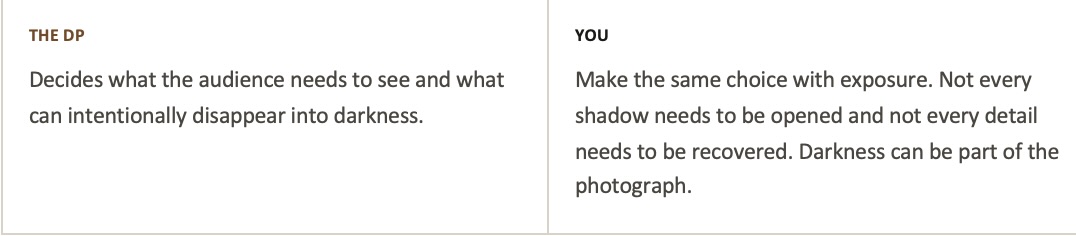
In other words, see the light before trying to fix the light.
Exposure isn't only technical. It's a creative decision.
Emmanuel Lubezki: Experience the Light That's Already There
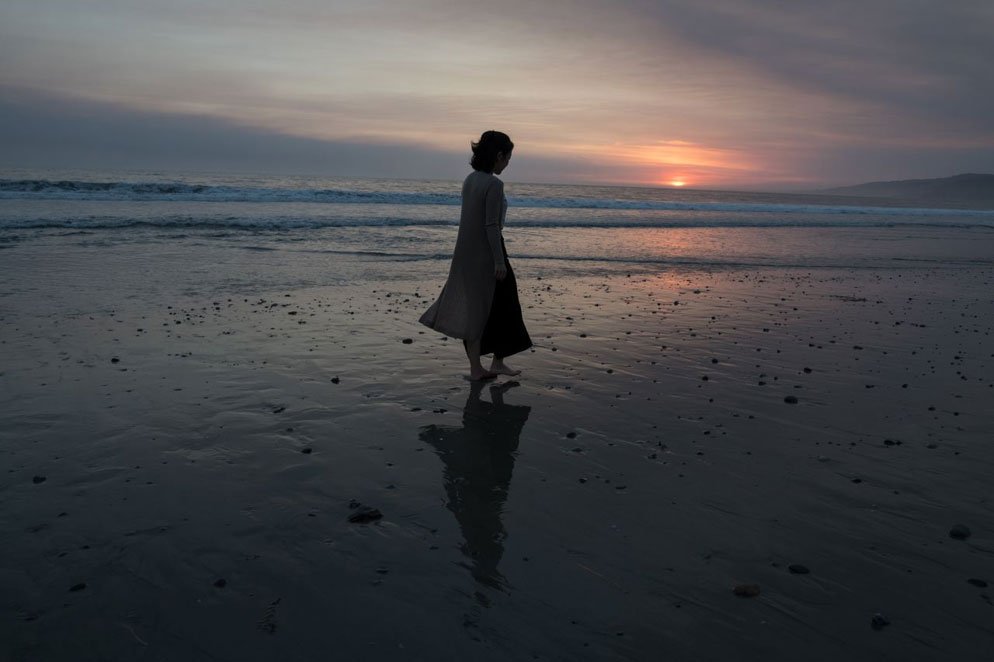
Then there's Emmanuel Lubezki, cinematographer of The Revenant, Birdman, Gravity and The Tree of Life. Lubezki's work offers another philosophy entirely.
For The Revenant, the filmmakers went to extraordinary lengths to work primarily with natural light and period-appropriate firelight. The restricted winter daylight became part of the production itself. For landscape photographers, this is a powerful reminder: Light isn't something that merely illuminates your subject. Light is part of your subject. A mountain at noon and the same mountain twenty minutes after sunset aren't merely two exposures of the same mountain.
They're two different photographs. Different emotion, color, texture, and story. Sometimes the photographer's most important piece of equipment isn't another lens. It's patience.
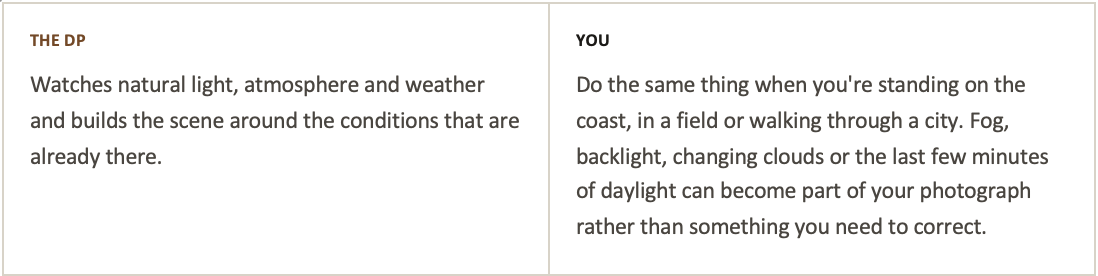
Sometimes the decision isn't changing a setting. It's recognizing the light.
THEIR CAMERA / YOUR CAMERA

But you're both making the same fundamental decisions:

Become the Director of Photography of Your Photograph
The next time you raise your camera, try delaying the shutter for ten seconds. Don't immediately ask: What's my aperture? Instead ask:
- What made me stop?
- What do I want someone else to notice?
- What should they feel?
- Where should their eye go first?
- What light communicates that feeling?
- Where should I position myself?
- What belongs in this frame?
- What doesn't?
Then choose your lens, position, composition, exposure, and finally press the shutter. That's a very different process from pointing a technically sophisticated camera at something beautiful.
The Camera Records. The Photographer Interprets.
This may be one of the most important distinctions in photography. Your camera can measure light, identify an eye, track a bird, calculate exposure and shoot dozens of frames per second. Increasingly, technology can even decide what constitutes a technically acceptable photograph.
But the camera doesn't stand on the edge of a field and decide: This should feel lonely, you do. And once you make that decision, aperture, shutter speed, ISO, lens, light, color, and composition stop being isolated technical skills. They become a visual vocabulary. That is the real lesson cinematographers can teach photographers. Don't just photograph what something looks like. Decide what you want someone to experience when they see it, becoming the Director of Photography, building the photograph around that intention.
Inspired? Step deeper into the experience. Explore our workshops, travel photography adventures, private sessions, and curated products designed to elevate your craft with confidence and clarity.
Enjoyed this article?
Join our newsletter for photography insights, class announcements, and creative inspiration delivered straight to your inbox.
We hate SPAM. We will never sell your information, for any reason.