The Photographer and AI
Apr 08, 2026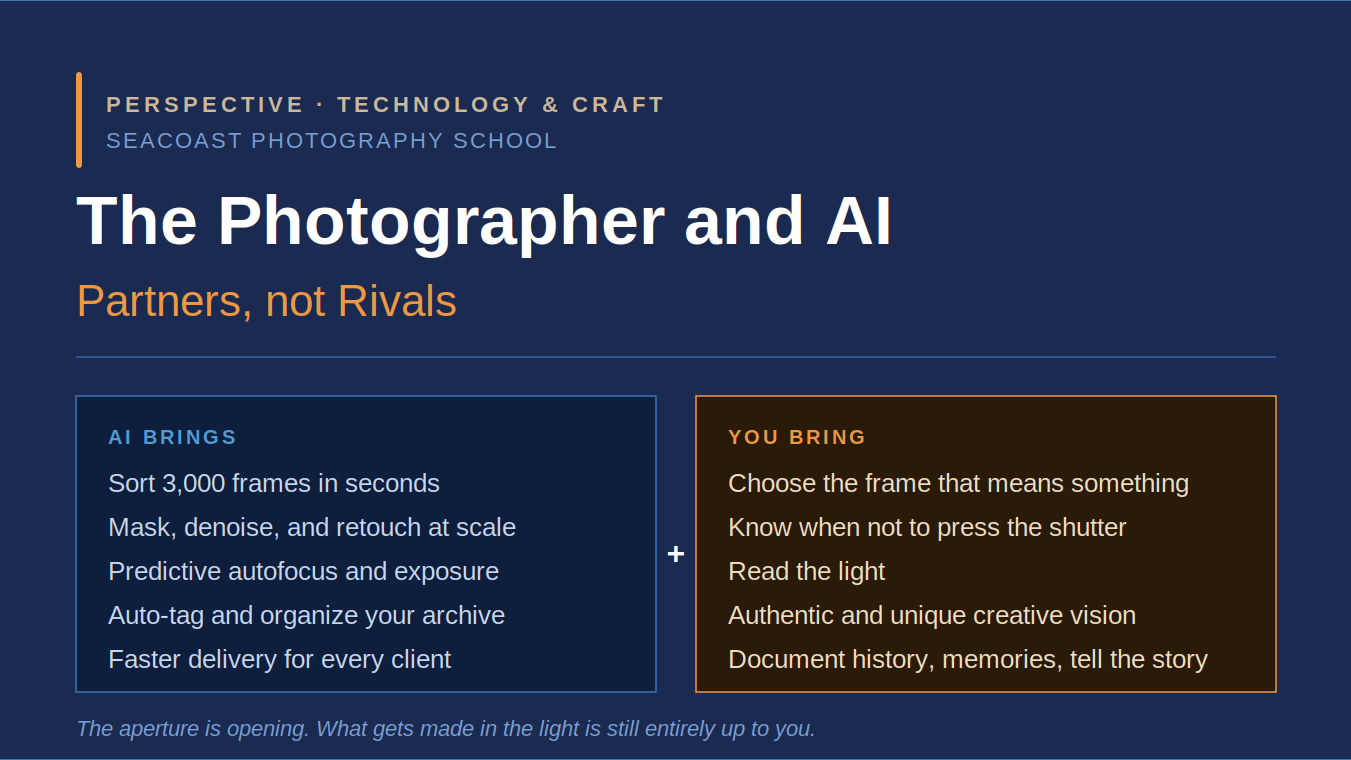
The Photographer and AI
Partners, not Rivals
Artificial intelligence isn’t coming for your eye. It’s coming for the work that kept your eye from the viewfinder. Here’s what that actually means for photographers who are navigating through the seas of change.
THE OLD ARGUMENT
A fear is circulating in photography circles in forums, workshops, and the quiet worries of working photographers that artificial intelligence has come to take something away. To automate the eye. To commoditize the vision. To replace the artist with a prediction engine trained on a billion borrowed images.
It is an understandable fear. It is also a mistaken one.
Not because AI is incapable it is extraordinarily capable. But because this framing misunderstandings of what photography actually is. And more importantly, it mistakes what has always happened when photographers encounter new technology. Film to digital triggered similar anxieties: the loss of artistic expression, the deskilling that ease would bring, the fear of the unfamiliar. What followed was the opposite. Adaptation produced new modes of expression.
“I don’t think we’ve even seen the tip of the iceberg. I think the potential of what technology is going to do to society, both good and bad, is unimaginable.”
— David Bowie
WHAT AI CAN AND CANNOT DO
Consider what artificial intelligence is genuinely extraordinary at. It can process a RAW file and make forty micro-adjustments to exposure, shadow recovery, and color grading faster than a human blinks. It can recognize a face in dim light and lock focus before the shutter hand has completed its press. It can sort 3,000 frames from a wedding and surface the twelve where every eye is open and every expression is genuine. These feats of scale and speed cannot be match by our biological systems.
But here is what AI cannot do: it cannot decide that the blurry frame, the one technically wrong by every measurable standard is the right one, because the motion blur captures exactly what the moment looks like. It cannot choose not to photograph a family in mourning because the ethics of that moment demand restraint. It cannot bring seventeen years of watching the light fall on a particular Maine coastline, and the embodied knowledge of where to stand when the fog lifts.
That is not AI. That is you.
AI does not replace the photographer’s eye. It frees the photographer’s hands so the eye can do what it has always done best: see what is actually there, and understand what it means.
THE DIVISION OF LABOR
The collaboration is already happening. In studios, galleries, and field assignments around the world, the pattern is consistent: wherever AI enters the workflow, it absorbs the computational burden of counting, sorting, predicting, adjusting. And wherever that burden lifts, the photographer is freed to be more present, more intentional, more human.
|
Moment |
AI handles |
You decide |
|
In the field |
Predictive autofocus, real-time exposure compensation, burst culling |
Which story to tell, where to stand, when to lower the camera |
|
In the edit |
Intelligent masking, skin tone normalization, noise reduction at scale |
The mood of the final image, what to emphasize, what to let go dark |
|
In the archive |
Auto-tagging, duplicate detection, subject and location recognition |
Which images carry lasting meaning, what deserves to be preserved |
|
In the studio |
Background generation, lighting simulation, retouching at speed |
The relationship with the subject w/ the trust that unlocks the image |
|
For the client |
Faster delivery, consistency across galleries, smart export formats |
Understanding what this moment means to this family, forever |
AI can replicate a style. It cannot originate meaning. It can simulate a street scene but it cannot stand in a crowded square and press the shutter at the exact moment an emotional gesture crosses a face. According to Adobe, AI-assisted tools; auto masking, subject detection and generative fill can reduce editing time by 30 to 80 percent depending on workflow complexity. That is not replacement. That is reclaimed time.
COLLABORATION HAS ALWAYS ELEVATED THE CRAFT
Photography has never been a purely solitary act of untouched vision. Ansel Adams worked in partnership with darkroom chemistry, large-format equipment, and the zone system, technologies that extended what his eye could hold. Henri Cartier-Bresson collaborated with the Leica’s mechanics: its small form, its capacity for invisibility, its engineering of the decisive moment. Every significant photographer has been in relationship with their tools, bending them toward a vision and being shaped by them in return.
AI is the newest and most powerful collaborator in that lineage. But the relationship remains unchanged: the tool serves the intention. The machine serves the mind behind it. What changes is the ceiling of what’s possible when human judgment and machine capability work as partners rather than adversaries.
“The whole is greater than the sum of its parts.”
— Aristotle
THE RISING FLOOR AND CEILING
For decades, photography had a gatekeeping mechanism: skill. To make a compelling image, a photographer had to understand light, composition, timing, and the limitations of the equipment. That barrier is dissolving. Modern mirrorless cameras already embed AI into autofocus, subject detection, and exposure systems. Add AI-assisted editing on top of that, and the baseline of “technically good” has never been more accessible.
This creates a paradox: when anyone can produce a technically sound image, technical execution stops being the differentiator. The floor rises. But so does the ceiling. The photographers who will define the next decade are not those who resist AI, nor those who blindly defer to it. They are those who understand that the partnership of AI’s speed, pattern recognition, and tireless processing combined with the photographer’s irreplaceable judgment, lived experience, and moral compass produces work that neither could make alone.
For the first time, the craft’s fullest potential is not limited by the hours in a day or the frames a human eye can review. The machine takes the weight. The photographer takes the wheel.
A NOTE ON WHAT WE’RE BUILDING TOGETHER
|
AI WARNING LABEL Artificial intelligence systems are created and deployed to achieve objectives through speed, scale, and pattern recognition. They are shaped by the priorities of those who build them, which may influence their outputs and decision-making in ways that are not always visible to the user. Every interaction you have with an AI system contributes to its ongoing development. Your images, your edits, your choices, these become part of the data that trains future models. In a real sense, photographers are teaching AI how to get better at photography. There is no neutral position here. The only question is whether you engage with awareness and intention, or not. If AI is Frankenstein, we provided the parts. Use these tools deliberately. Understand who built them, what they optimize for, and what you are contributing in return. Eyes open in every sense of the word. |
The aperture is opening. What gets made in the light is still entirely up to you.
Inspired? Step deeper into the experience. Explore our workshops, travel photography adventures, private sessions, and curated products designed to elevate your craft with confidence and clarity.
Enjoyed this article?
Join our newsletter for photography insights, class announcements, and creative inspiration delivered straight to your inbox.
We hate SPAM. We will never sell your information, for any reason.